

May 12, 2026
If your organization sends both optional newsletters and legally required notices, you have probably run into this problem: a contact unsubscribes, then calls asking why they never received an important update. The answer lies in understanding which emails actually require an unsubscribe mechanism and which ones do not.
This post explains what Canadian law says, where the grey areas are, and how purpose-built tools handle the distinction by default.
In this post
- Why contacts unsubscribing creates a bigger problem than most platforms recognize
- What CASL actually says about unsubscribe requirements
- The three types of email your organization sends
- When you can legally send emails without an unsubscribe link
- The grey areas communicators most often get wrong
- How Mandatory Messaging works in practice
1. Why contacts unsubscribing creates a bigger problem than most platforms recognize
When a contact unsubscribes, most email platforms remove them from every list at once. For organizations that send both optional content and legally required communications, that creates a real problem. The contact misses critical information, has no idea it was sent, and your team has no reliable way to reach them outside of manual workarounds.
Most email platforms are built for marketers, where unsubscribe logic is binary: a contact is either in or out. That makes sense for a retail brand sending promotional emails. It does not reflect how public sector communicators actually work.
A university sends course registration reminders and campus event newsletters. A municipality sends emergency alerts and community recreation updates. A regulatory body sends required compliance notices and optional industry news. These are not the same type of email, and treating them the same creates gaps in critical communication.
2. What CASL actually says about unsubscribe requirements
CASL, Canada’s Anti-Spam Legislation, only applies to Commercial Electronic Messages and Digital Technology. A message is commercial if it encourages participation in a commercial activity. If an email does not meet that definition, CASL’s unsubscribe requirements do not apply. That covers a significant portion of the communications that public sector organizations send regularly.
A tuition payment reminder is not a Commercial Electronic Message. Neither is a bylaw change notice, or a staff policy update. None of these encourage someone to buy something or engage in a commercial transaction.
The distinction matters because it means many of the emails your organization sends fall outside CASL’s scope, not because you are exempt from the law, but because those messages do not meet the legal definition of a commercial communication.
3. The three types of email your organization sends
Most organizations send three fundamentally different types of email: opt-in messages that contacts choose to receive, internal operational messages based on an organizational relationship, and mandatory messages that contacts are legally or contractually required to receive. Only opt-in messages operate under standard unsubscribe rules.
Opt-in emails are newsletters, event announcements, and any content a contact actively chose to receive. CASL applies here, and contacts can unsubscribe at any time.
Internal emails are operational messages sent based on a contact’s relationship with your organization. A staff policy update, a member renewal reminder, or a student financial aid notice falls here. These messages are not promotional, but they are also not strictly mandatory.
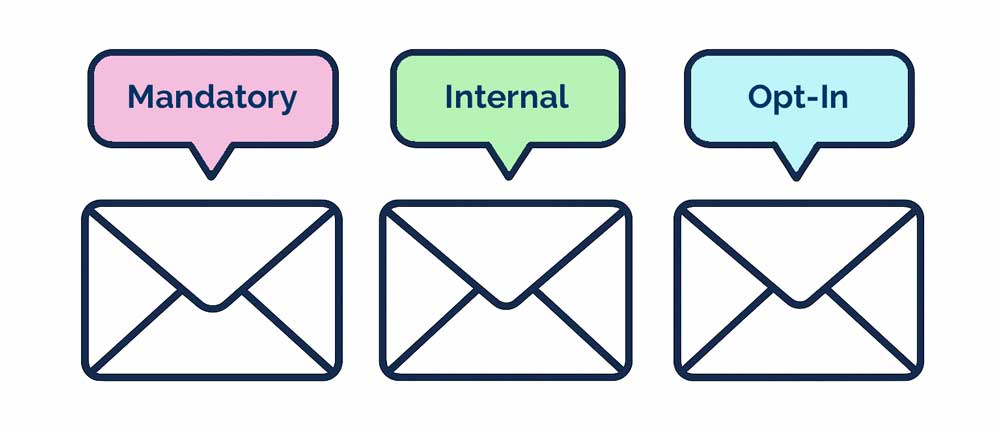
Mandatory emails are communications that contacts must receive because of a legal obligation, a regulatory requirement, or a contractual relationship. A contact cannot opt out of these messages, because your organization has a documented obligation to send them.
4. When you can legally send emails without an unsubscribe link
You can legally send emails without a standard unsubscribe link when those messages are not Commercial Electronic Messages under CASL. That includes internal operational communications, safety and compliance notifications, legally required notices, and messages tied to a contractual obligation between your organization and the recipient.
Common examples include:
- Campus safety alerts and emergency notifications
- Tuition payment reminders and registration hold notices
- Required regulatory notices from associations or governing bodies
- Policy or terms of service updates mandated by contract
- Internal HR or compliance communications sent to staff
A useful decision test: if the recipient must receive this message to fulfill their role, comply with their membership, or meet a requirement tied to their registration or employment, it likely does not require a standard unsubscribe mechanism.
5. The grey areas communicators most often get wrong
Several common email types sit in a grey zone where the line between operational and commercial is genuinely unclear. Treating a commercial message as transactional can put you in violation of CASL. Treating a required communication as optional can mean critical information never reaches the people who need it.
Internal newsletters are the most common grey area. If your member or staff newsletter includes only operational updates, it may not require an unsubscribe link. Add a promotional element and the picture changes.
Event invitations are usually commercial, even when sent to existing members or contacts, because they encourage participation in an activity. Product or service updates sit in similar territory: a functional change notice is one thing, but a message that promotes new features crosses into commercial territory.
When in doubt, the safer framing is this: if it markets, promotes, or nudges behavior, it is probably commercial.
6. How Mandatory Messaging works in practice
Mandatory Messaging lets your organization send emails to contacts who are legally or contractually required to receive them, even if those contacts have previously unsubscribed. It is a distinct message type that keeps required communications separate from optional ones, so contacts retain full control over what they choose to receive while your organization meets its obligations.
When composing a mandatory message in Envoke, you provide the contractual or regulatory reason that requires the send, along with a link to a verifying document. That reason and link appear in the footer of every mandatory email, so recipients understand why they are receiving it.
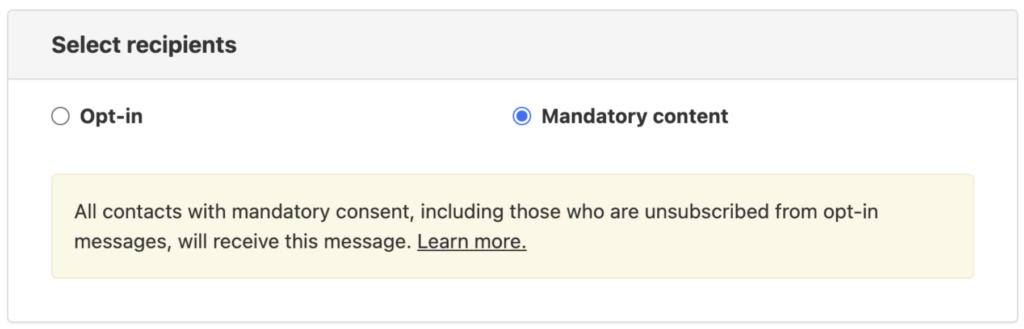
Contacts cannot self-serve unsubscribe from mandatory messages. Instead, every mandatory email links to a page where they can submit a removal request with a reason, which an admin at your organization reviews. This creates a dialogue rather than a one-click opt-out, which reduces the likelihood that contacts will mark your messages as spam.
Mandatory Messaging is currently unique to Envoke. It is not offered by Mailchimp, Constant Contact, or any other mainstream email marketing platform.
Most email platforms don’t offer Mandatory Messaging because they were never designed for this use case. They are built to help companies acquire customers and drive conversions, so the assumption baked into their unsubscribe logic is that every contact is a potential buyer who can always opt out. That model doesn’t account for organizations with legal or contractual obligations to their members, students, constituents, or staff.
Mandatory Messaging is currently unique to Envoke. It is not offered by Mailchimp, Constant Contact, or any other mainstream email platform
Frequently asked questions
Does CASL require an unsubscribe link on every email?
No. CASL only requires unsubscribe mechanisms on Commercial Electronic Messages, defined as messages that encourage participation in a commercial activity. Operational communications, safety alerts, and legally required notices typically fall outside this definition and do not require a standard unsubscribe link.
What is the difference between a transactional email and a mandatory email?
A transactional email is triggered by a specific user action, such as a password reset or a purchase receipt. A mandatory email is one that an organization has a legal or contractual obligation to send, regardless of whether the recipient has previously unsubscribed. Both types generally do not require a standard unsubscribe link, but the reason is different in each case.
Can I send a mandatory email to someone who has already unsubscribed?
Yes, if you have a documented legal or contractual obligation to send that email. Under CASL, messages that are not Commercial Electronic Messages are not subject to the same consent and unsubscribe requirements. In Envoke, Mandatory Messaging is designed for this use case and requires you to provide a verifiable reason for each mandatory send.
What happens if a contact wants to be removed from a mandatory list?
In Envoke, every mandatory email includes a link to a removal request page where the contact can explain why they would like to be removed. An admin at your organization reviews each request individually. This process replaces the one-click unsubscribe with a dialogue, which reduces spam complaints and ensures legitimate removal requests are handled appropriately.
Which organizations can use Mandatory Messaging?
Any organization that can demonstrate a legal or contractual obligation to deliver emails to contacts can request Mandatory Messaging through Envoke’s Professional billing plan. Common users include regulatory bodies, post-secondary institutions, municipalities, public health, and associations.
Related Articles:
About the Author
Zoltan Wagner is a Product Manager at Envoke with over 15 years of experience in product development, specializing in email marketing technology and leading iterative improvements that enhance platform usability and performance.